Back to BlogAI Customer Service Statistics 2026: ROI & Pakistan Trends
Table of contents
Chatbot Basics
AI Customer Service Statistics 2026: ROI & Pakistan Trends
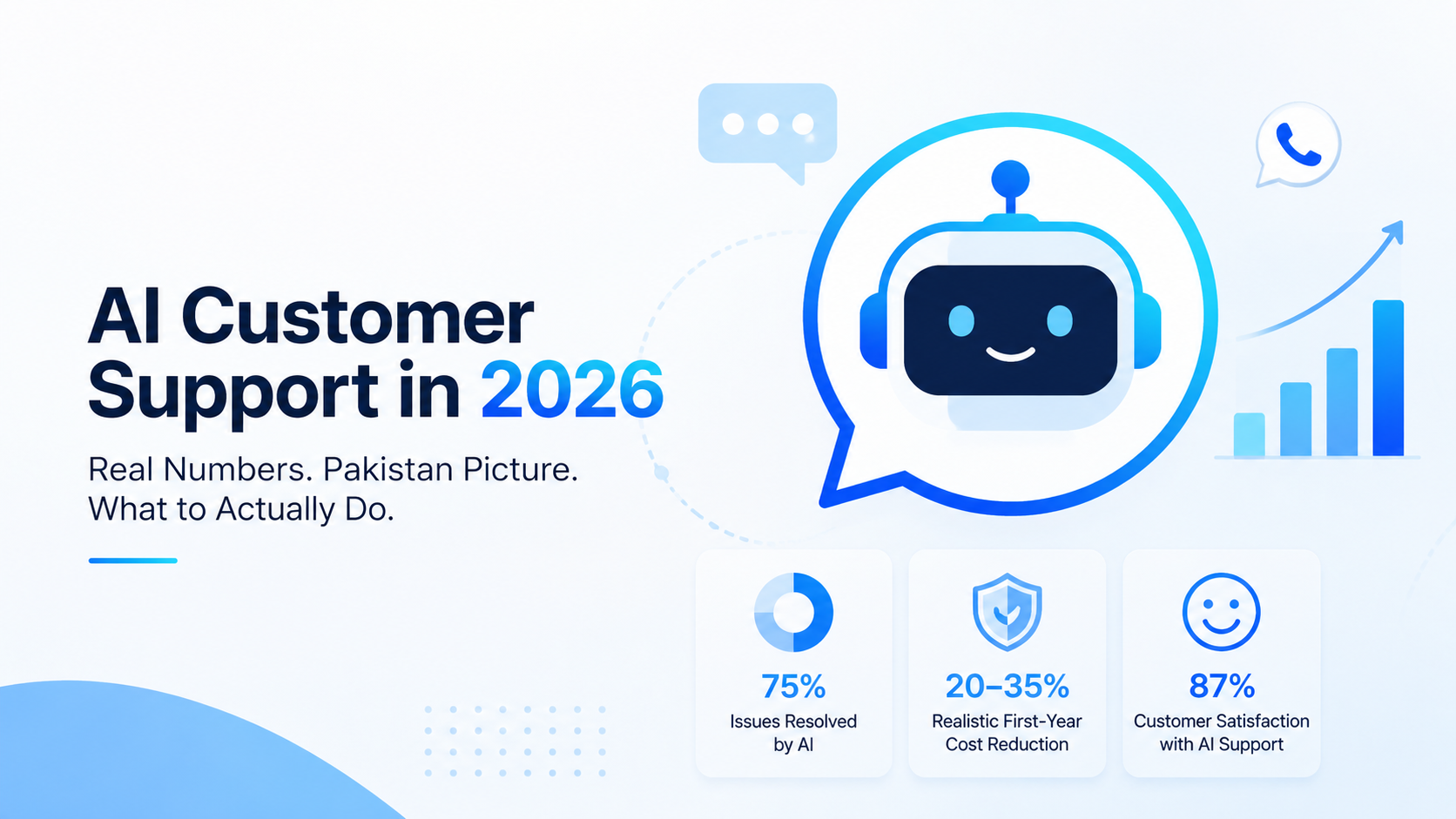
An insider’s overview of AI-powered customer support in 2026, with real figures, Pakistan-specific insights, cost reality checks, and practical takeaways.
AI customer service is the use of artificial intelligence to answer customer questions, automate routine support tasks, and assist human agents. In 2026, businesses are adopting it to improve response speed and reduce support costs, with well-integrated systems offering the strongest results while still escalating complex or sensitive issues to human agents.
The Market Is Real — And Growing Fast
The Market Is Real — And Growing Fast
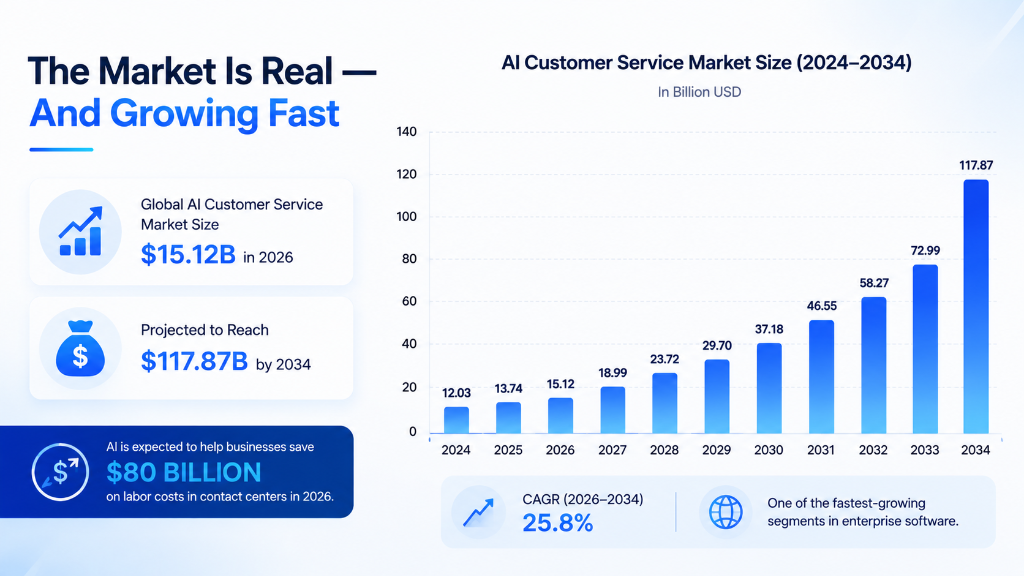
The global market for AI customer service is predicted to generate $15.12 billion in 2026, experiencing an average annual growth of 25.8% and reaching nearly $117.87 billion by 2034. It is no longer a niche segment — it is one of the fastest-growing categories in enterprise software. The primary economic driver is clear: conversational AI is expected to help businesses save nearly $80 billion in contact center labor costs during 2026 alone.
However, surging spend does not equal implementation maturity:
88% of contact centers already utilize some form of AI.
Only 25% have completed deep workflow integration.
Most organizations are stuck in the gap between "we bought an AI tool" and "we trust it enough to route real customers to it". That gap is where competitive advantage is won.
What Customers Think About Chatting to a Bot
What Customers Think About Chatting to a Bot
Vendor pitch decks often simplify customer sentiment into a single bullet point. Here is the full picture:
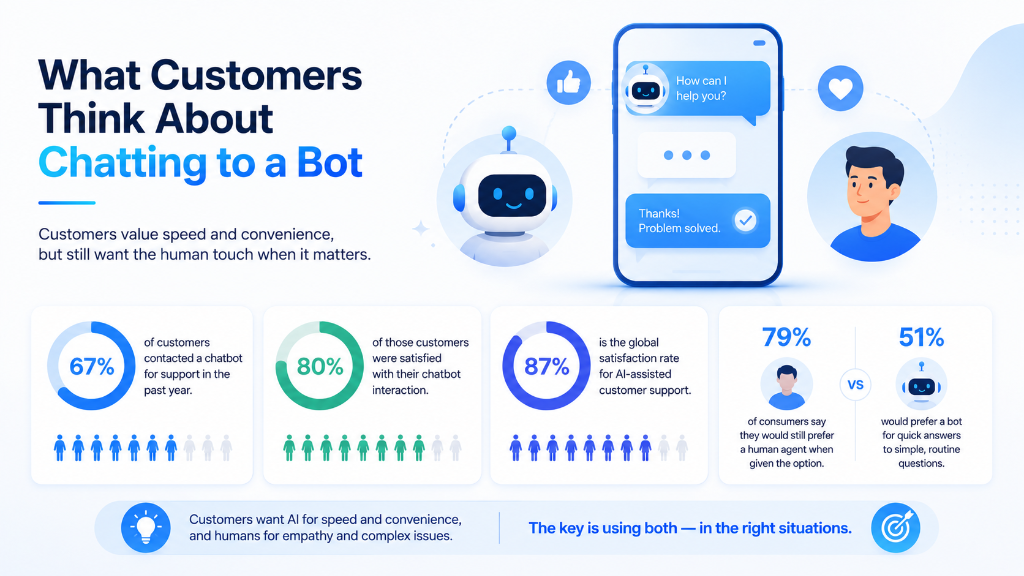
67% of customers contacted a chatbot for support in the past 12 months, and 80% of them reported a positive experience. Current global satisfaction for AI-assisted support sits at 87%.
At the same time, 79% of consumers state they prefer a human agent overall — while 51% prefer a bot if it delivers a faster answer.
These data points do not contradict each other. Customers want AI for quick, repetitive, and transactional queries, but demand human empathy for complex or sensitive problems. Forcing bots to pretend to be human fails; designing them for speed and clarity succeeds.
What AI Can Actually Handle
What AI Can Actually Handle
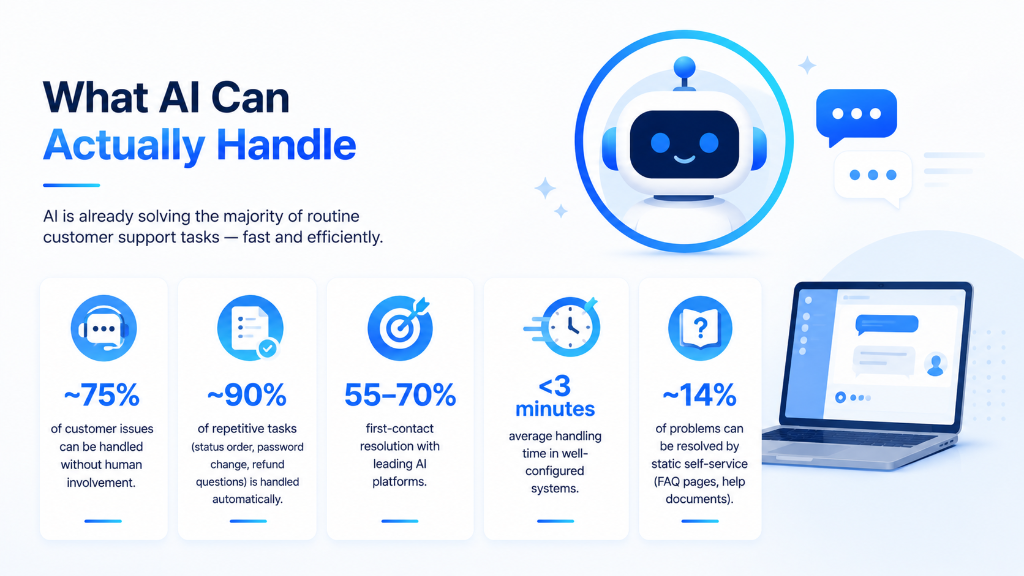
Here is what well-integrated conversational AI systems deliver in 2026:
~75% of customer issues can be handled without human intervention.
~90% of repetitive requests (order status, password resets, basic returns) are automated smoothly.
Leading AI platforms achieve 55–70% first-contact resolution rates.
Average handling time drops below 3 minutes in optimized deployments.
Static self-service (FAQ pages, help center docs) resolves only ~14% of queries independently.
How Much Can AI Customer Service Reduce Costs in 2026?
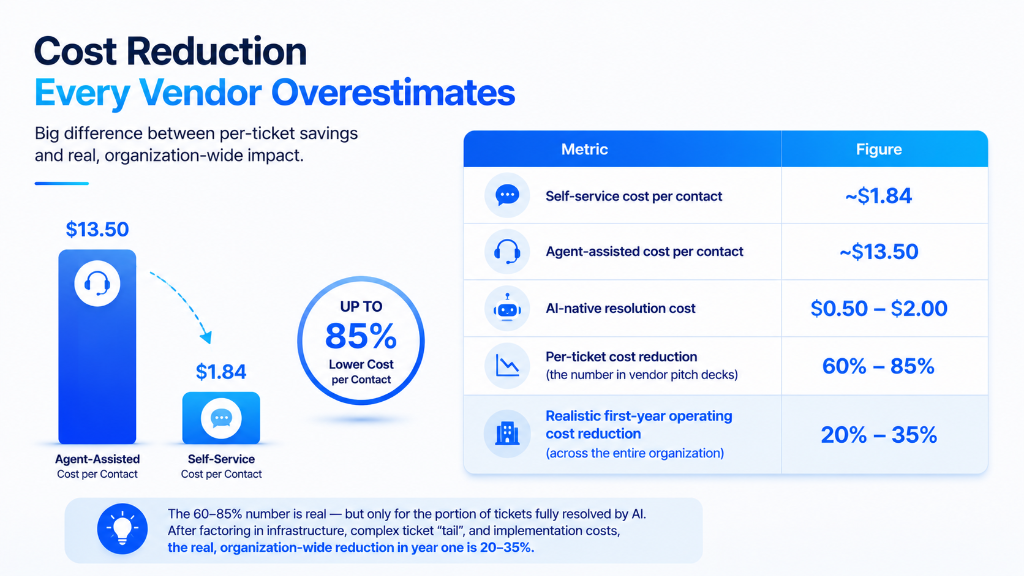
Cost Reduction Every Vendor Overestimates
This is the single most critical metric to analyze when building your business case:
Metric
Figure
Self-service cost per contact
~$1.84
Agent-assisted cost per contact
~$13.50
AI-native resolution cost
$0.50-$2.00 per ticket
Per-ticket cost reduction (the number in vendor pitch decks)
60-85%
Organization-wide net cost reduction, year one (the realistic number)
20-35%
The 60–85% figure cited by vendors is accurate for the specific subset of tickets fully handled by AI. However, factoring in software licenses, setup costs, edge cases, and human escalation overhead, a realistic net cost reduction across your entire support operation in Year 1 is 20–35%.
This is still a substantial return, but it demands realistic budgeting rather than inflated expectations.
No, AI Is Not Replacing Your Support Team
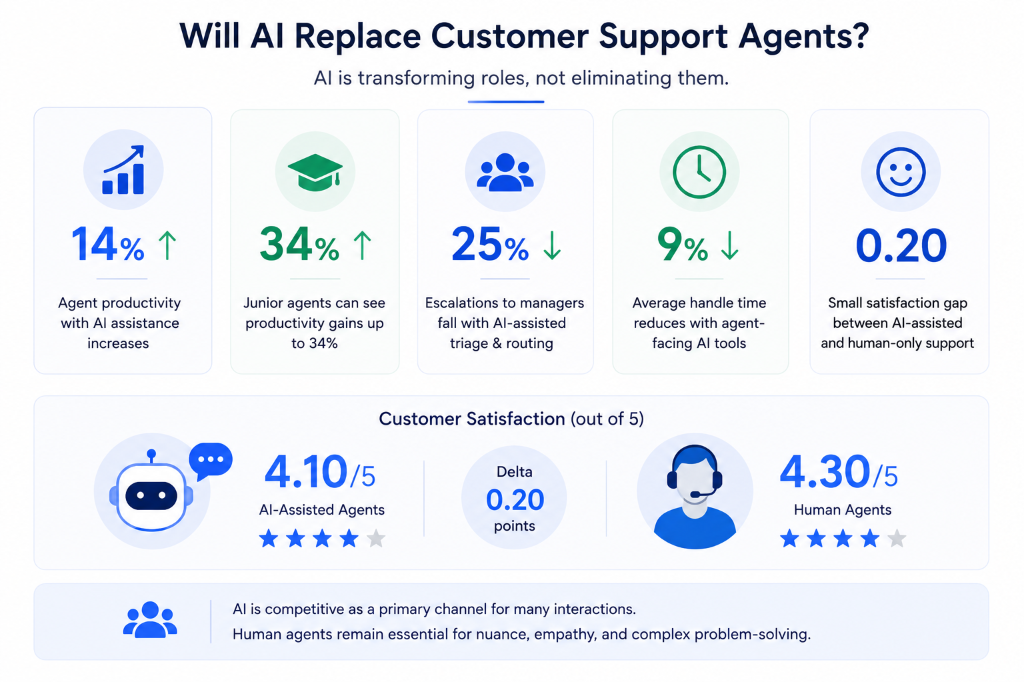
Will AI Replace Customer Support Agents?
Agent Productivity: Agent output increases by ~14% with AI copilot tools; junior agents see productivity gains up to 34%, drastically shortening onboarding time.
Fewer Manager Escalations: Tier-1 manager escalations drop by 25% through automated triage and smart routing.
Minimal CSAT Delta: Customer satisfaction scores for AI-assisted support (4.10/5) are nearly comparable to human-only support (4.30/5).
Headcount Impact: Only 20% of organizations reduce support team size after adopting AI. Gartner projects that by 2027, half of those companies will rehire workers for similar roles with updated job titles.
Which Use Cases Are Popular in AI Adoption Right Now
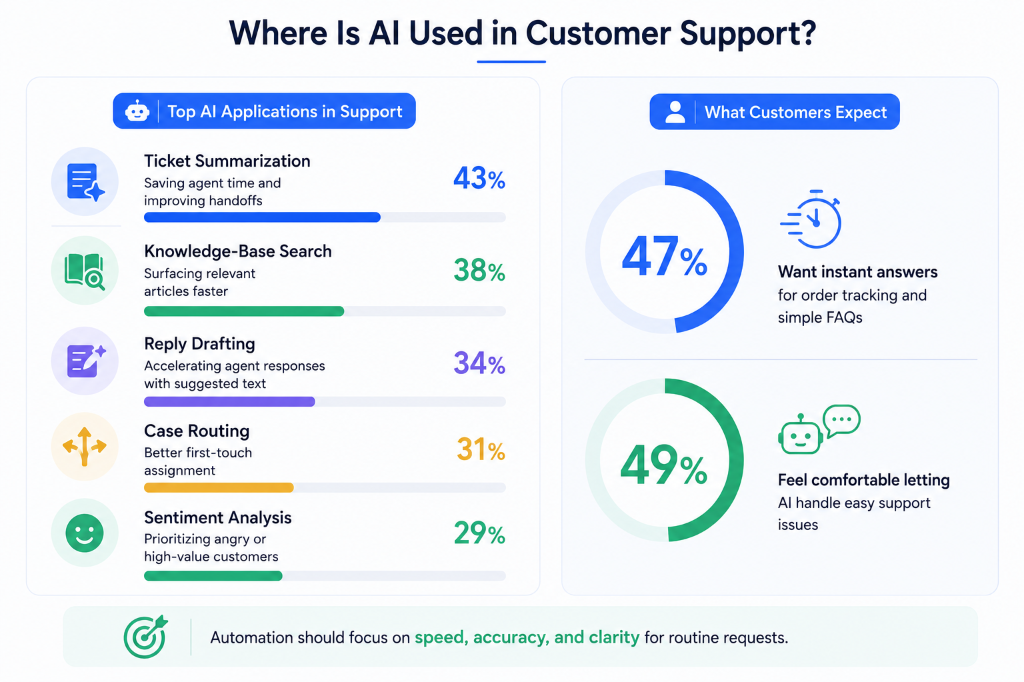
Where Is AI Used in Customer Support Operations?
The most popular AI features deployed by support teams include:
34%: Reply drafting (suggested responses for agents)
31%: Case routing (intelligent ticket assignment)
29%: Sentiment analysis (prioritizing high-value or dissatisfied buyers)
From the customer side, 47% expect instant answers for order tracking and basic FAQs, while 49% are comfortable letting AI handle straightforward tasks.
Adoption Varies Strongly Depending on Industry
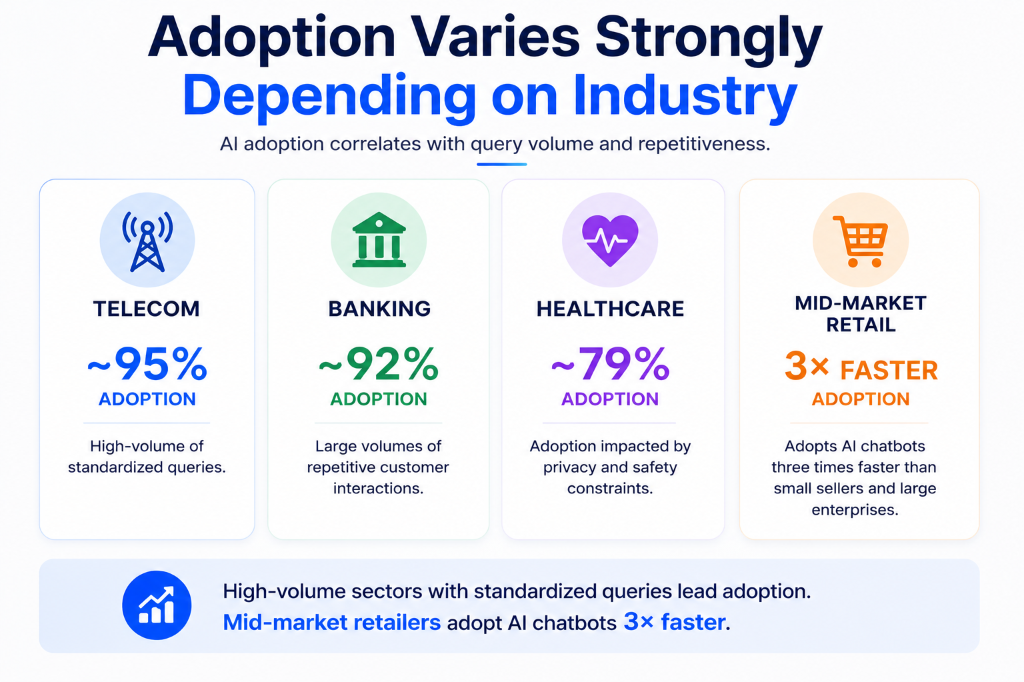
Adoption Varies Strongly Depending on Industry
Industry adoption is heavily dictated by query volume and repetitiveness:
Telecom (~95%) and Banking (~92%) lead global adoption due to high volumes of standardized requests.
Healthcare (~79%) grows steadily despite strict compliance and data privacy requirements.
Mid-market Retailers adopt AI chatbots 3x faster than small merchants or mega-enterprises, driven by the need to scale support without expanding headcount linearly.
The Picture of AI Adoption in Pakistan in 2026
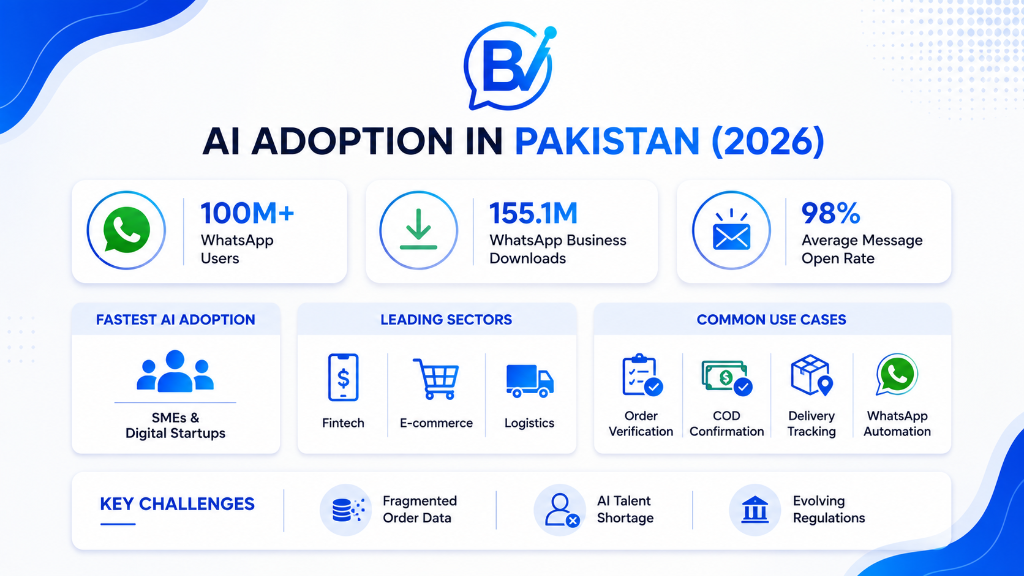
AI Adoption in Pakistan (2026)
Most global guides assume customer support happens on a website chat widget — which does not reflect business realities in Pakistan. Here is the actual local landscape:
WhatsApp Dominance: Pakistan is a top global market for WhatsApp adoption, with over 100+ million active users and 155.1 million cumulative downloads of WhatsApp Business.
98% Open Rates: WhatsApp messages achieve an average 98% open rate, making WhatsApp automation (order verification, Cash-on-Delivery confirmation, delivery tracking) exponentially more valuable for Pakistani e-commerce than website widgets.
SMEs Lead the Charge: Unlike Western markets where large enterprises adopt AI first, Pakistani SMEs and digitally-native startups are adopting AI faster due to agility and lean team sizes.
High-Adoption Sectors: Fintech, e-commerce, and logistics lead local adoption because they already operate on structured transactional data.
Daraz & Marketplace Workaround: Because major platforms like Daraz do not share buyer phone numbers with sellers, Pakistani merchants use "Click-to-WhatsApp" links in product listings to transition customers onto WhatsApp and automate post-purchase support.
Key Local Challenges: Fragmented order data, shortage of specialized AI talent, and evolving local regulatory frameworks.
Built for WhatsApp-First Commerce
This is exactly the gap Botvee was built to solve. Botvee (botvee.ai) is designed specifically for WhatsApp, Messenger, and webchat. If you run an e-commerce brand, fintech, or service business in Pakistan, Botvee's free plan allows you to automate order tracking, COD confirmation, and FAQs on WhatsApp without upfront risk.
Metrics to Track Once You're Ready to Go Live
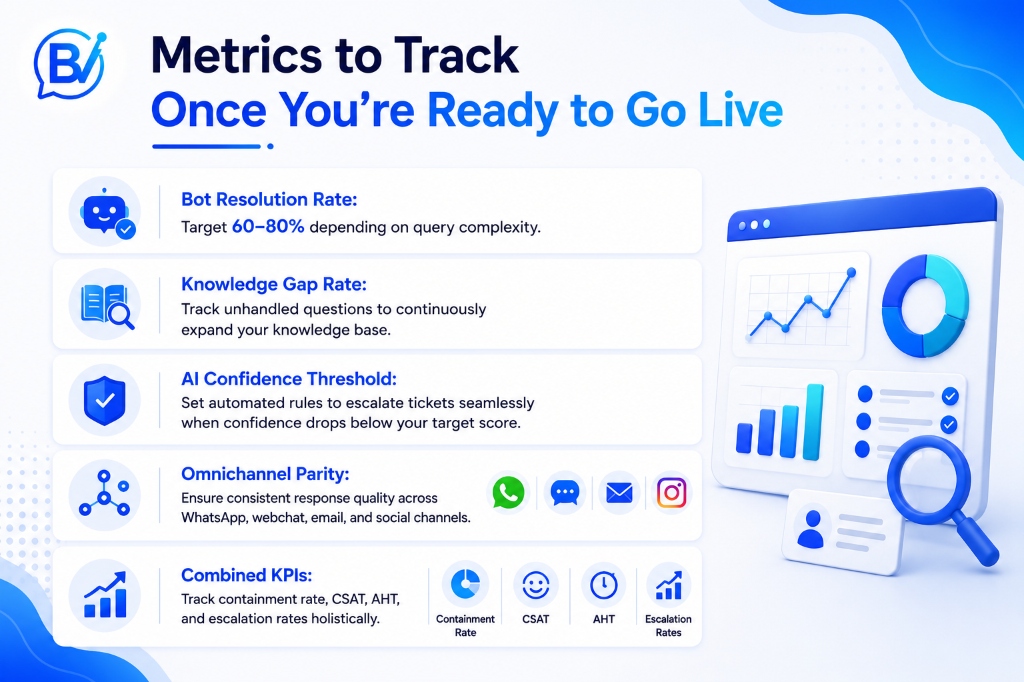
Metrics to Track Once You're Ready to Go Live
Bot Resolution Rate: Target 60–80% depending on query complexity.
Knowledge Gap Rate: Track unhandled questions to continuously expand your knowledge base.
AI Confidence Threshold: Set automated rules to escalate tickets seamlessly when confidence drops below your target score.
Omnichannel Parity: Ensure consistent response quality across WhatsApp, webchat, email, and social channels.
Golden Rule: Any query flagged with negative sentiment or dropping below your confidence threshold must automatically route to a human agent — zero exceptions.
How Do I Implement AI Customer Support for E-Commerce?
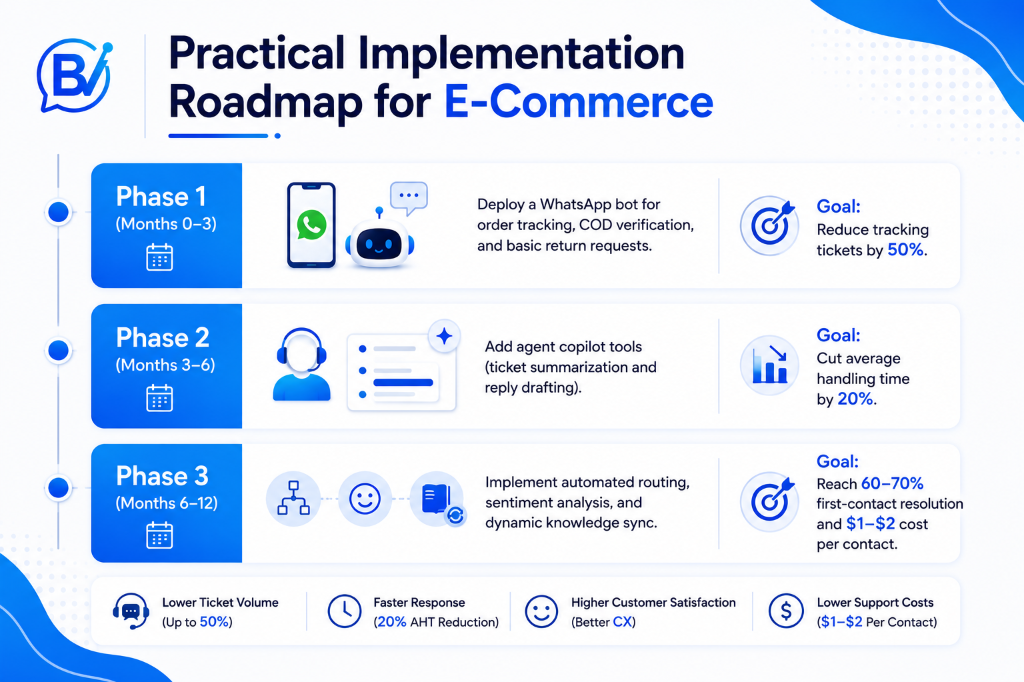
Practical Implementation Roadmap for E-Commerce
Phase 1 (Months 0–3): Deploy a WhatsApp bot for order tracking, COD verification, and basic return requests. Goal: Reduce tracking tickets by 50%.
Phase 2 (Months 3–6): Add agent copilot tools (ticket summarization and reply drafting). Goal: Cut average handling time by 20%.
Phase 3 (Months 6–12): Implement automated routing, sentiment analysis, and dynamic knowledge sync. Goal: Reach 60–70% first-contact resolution and $1–$2 cost per contact.
Risks to Plan For, Not Ignore
Over-automation Frustration: Always provide a 1-tap escalation button to reach a human agent.
Hallucinations & Inaccurate Data: Invest in continuous data review loops to keep answers accurate.
Language & Cultural Context: Localize AI prompts for Roman Urdu, English, and local phrasing.
Data Privacy & Security: Use end-to-end encryption and adhere to data minimization best practices.
Bottom Line
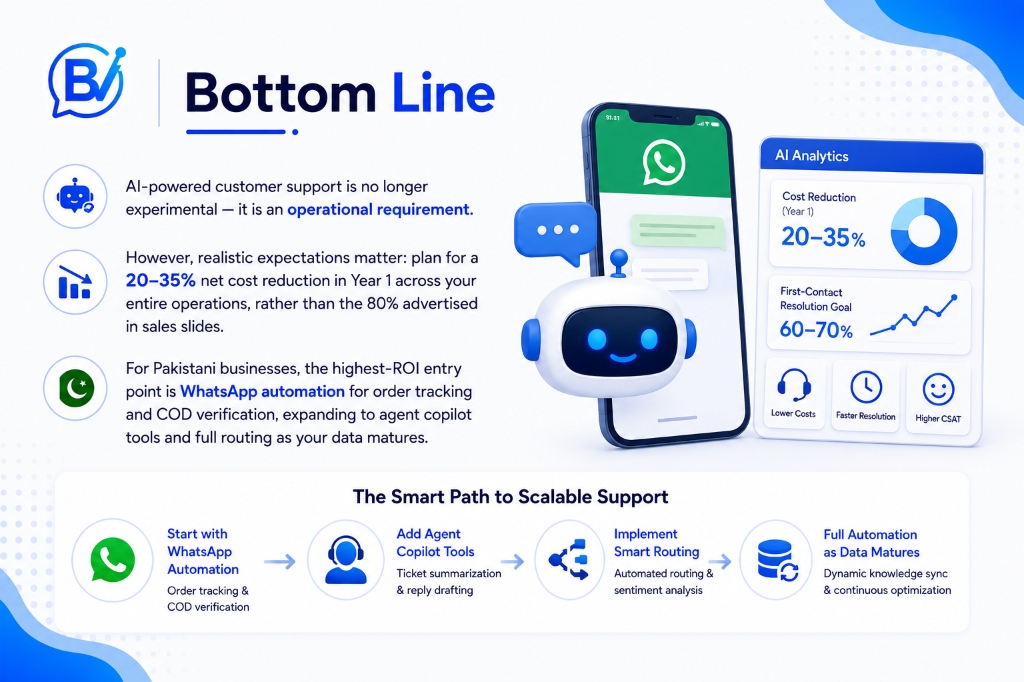
Bottom Line
AI-powered customer support is no longer experimental — it is an operational requirement. However, realistic expectations matter: plan for a 20–35% net cost reduction in Year 1 across your entire operations, rather than the 80% advertised in sales slides. For Pakistani businesses, the highest-ROI entry point is WhatsApp automation for order tracking and COD verification, expanding to agent copilot tools and full routing as your data matures.
Ready to see how AI performs for your business? Test Botvee's free plan at botvee.ai — deploy your AI agent on WhatsApp or webchat in minutes and measure real resolution rates without commitment.
Frequently Asked Questions (FAQ)
Q1: Is AI actually replacing customer support agents in 2026?
No. Only about 20% of companies cut headcount due to AI adoption, and Gartner forecasts that half of those will rehire by 2027 in different positions. AI is mainly decreasing escalations and increasing agent productivity, not eliminating roles.
Q2: How much can I save in my business by adding AI to customer support?
Vendor marketing decks often claim 60–85% cost reductions, but that applies per ticket only for the subset resolved entirely by AI. Across your entire support operation — factoring in infrastructure and complex tickets — a realistic net cost reduction in year one is 20–35%.
Q3: Do customers actually prefer to talk to a bot?
It depends on the task. For quick, transactional requests (order status, tracking), 51% prefer a bot for speed. However, 79% still prefer a human overall, especially for complex or sensitive issues.
Q4: Is AI customer support applicable for small businesses in Pakistan?
Yes — even more so than in many Western markets. Pakistani SMEs and startups are currently leading local AI adoption. The lowest-friction entry point is WhatsApp automation for order tracking, FAQ handling, and COD confirmation, leveraging WhatsApp's 98% open rate.
Q5: What is the main local barrier to AI adoption in Pakistan?
Data quality and fragmentation, rather than a lack of interest or budget. Businesses want AI, but often lack clean, structured order data and specialized local AI talent.
Q6: Where should I start if I am implementing AI support for the first time?
Start small on WhatsApp with one or two high-volume, low-complexity use cases (order tracking, basic returns) and enforce strict human escalation rules when confidence is low. Platforms like Botvee (https://botvee.ai) allow you to test this setup on a free plan before scaling.
Note: Pakistan-specific figures are synthesized from industry research, ecommerce benchmarks, and market analysis blogs.
Recommended articles
Chatbot Basics
NLP vs Rule-Based Chatbots: Which Cuts Support Costs Faster?
Compare NLP and rule-based chatbots on speed, accuracy, containment, and cost. See 2026 benchmarks and choose the right one to actually reduce your support costs.