Chatbot Basics
AI Customer Service Statistics 2026: ROI & Pakistan Trends
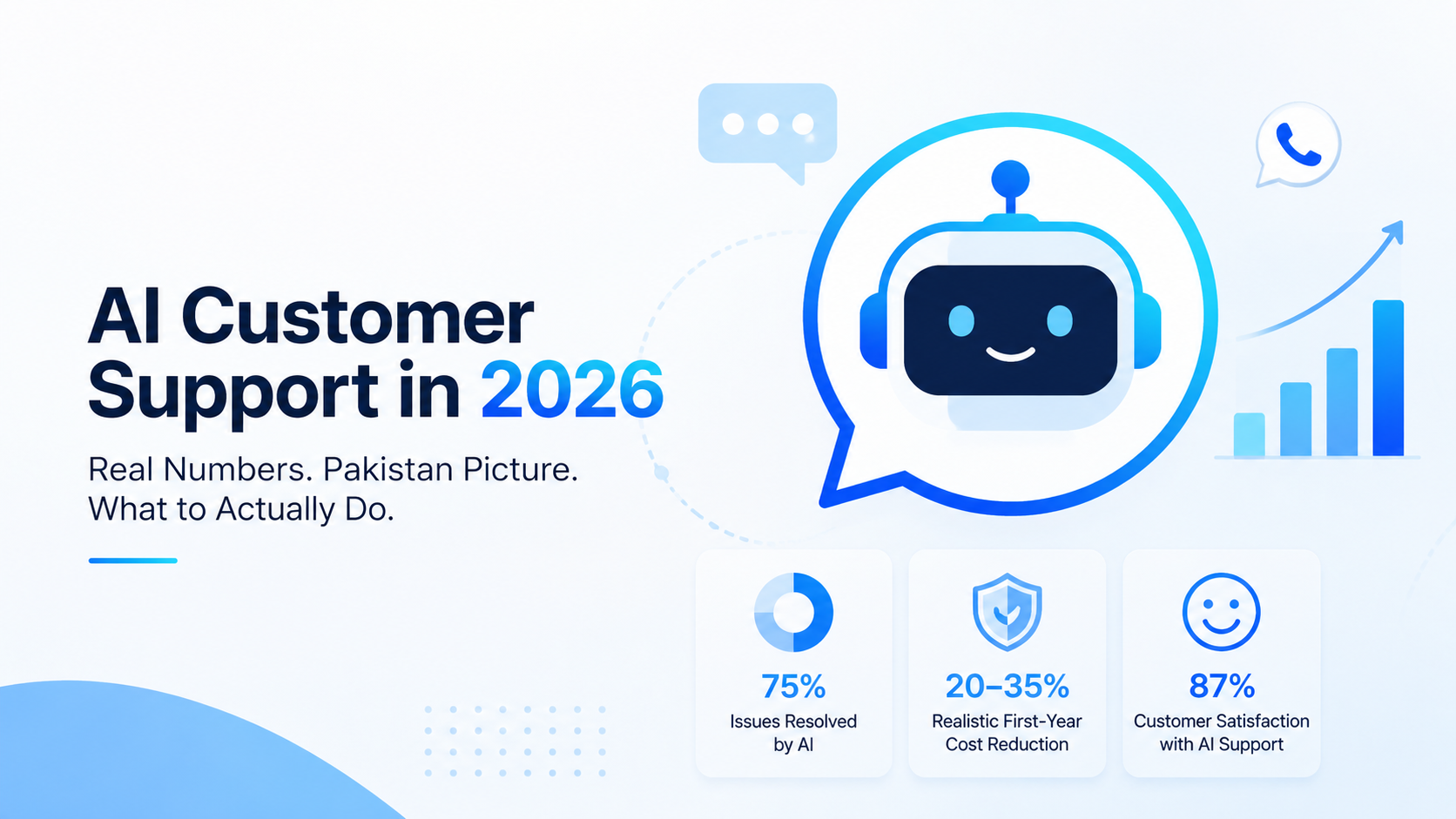
An insider’s overview of AI-powered customer support in 2026, with real figures, Pakistan-specific insights, cost reality checks, and practical takeaways.
10 min read
Compare NLP and rule-based chatbots on speed, accuracy, containment, and cost. See 2026 benchmarks and choose the right one to actually reduce your support costs.
Summarize this post with AI
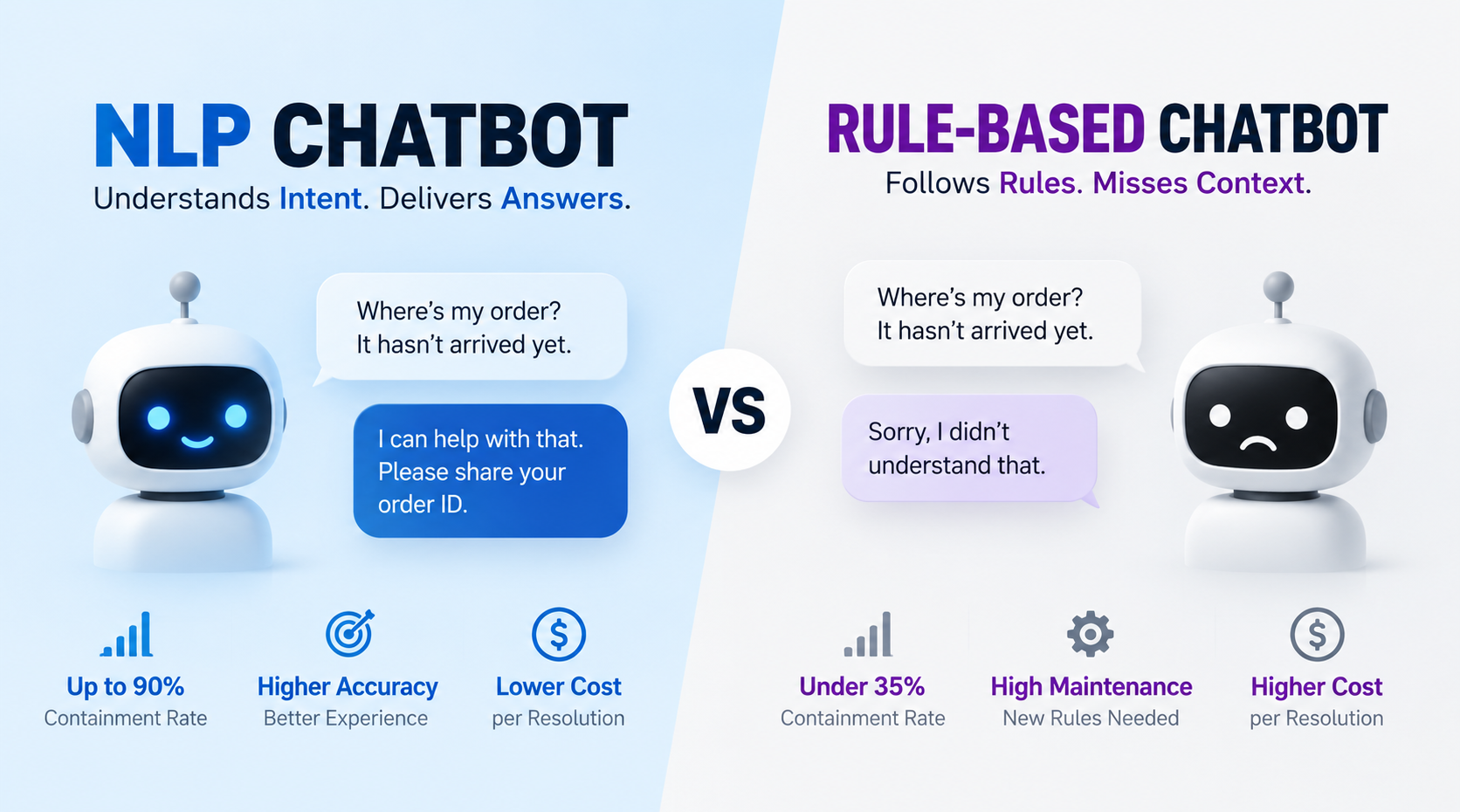
Rule-based chatbots are cheaper and simpler for basic FAQs, while NLP chatbots understand user intent and handle more complex conversations. For most businesses focused on reducing support costs, NLP chatbots are the better long-term choice because they scale better, require less manual maintenance, and can resolve a higher percentage of customer queries.
If you're looking at chatbots to reduce customer support costs, the single most crucial decision is rule-based vs NLP.
It may seem like semantics on the surface: a chat interface with automated replies. But inside it is a world of difference. And getting it wrong may quietly raise your support costs instead of lowering them.
Below I break down what makes each type unique, what the benchmarks for 2026 look like, and which chatbot type cuts your support cost faster. If chatbots are new territory for you, go through our guide on what an AI chatbot really is first, then come back.
A rule-based chatbot is a flowchart with chat UI. You specify keywords, buttons, decision paths, and the bot follows them exactly.
A typical flow is like this:
User clicks "Track my order" button → Bot asks for an order number → User enters it → Bot gets status → Bot replies.
If the user types "where's my package?" instead of pressing the button, an entry-level rule-based bot won't recognize the request unless that particular phrase has been added to the keyword list.
That is what makes most rule-based implementations stagnant. Industry benchmark for containment shows that rule-based bots without AI fall under 35% — meaning that at least 6 out of 10 conversations still require a human to process.
Unlike rule-based bots, NLP (natural language processing) bots don't rely on hardcoded logic but read the input message and identify the intent behind it, extract entities, and then provide a reply.
The same order-status case, for example:
User types "hey my order is still not here, what's up?"
Bot detects: intent =
order_status, entity = (need to ask for the order ID)Bot replies "Sure, please provide me with order number."
The user may have asked "where is my package?", "package has not arrived yet", or anything else — all get translated to the same intent and routed. That is the main idea behind it.
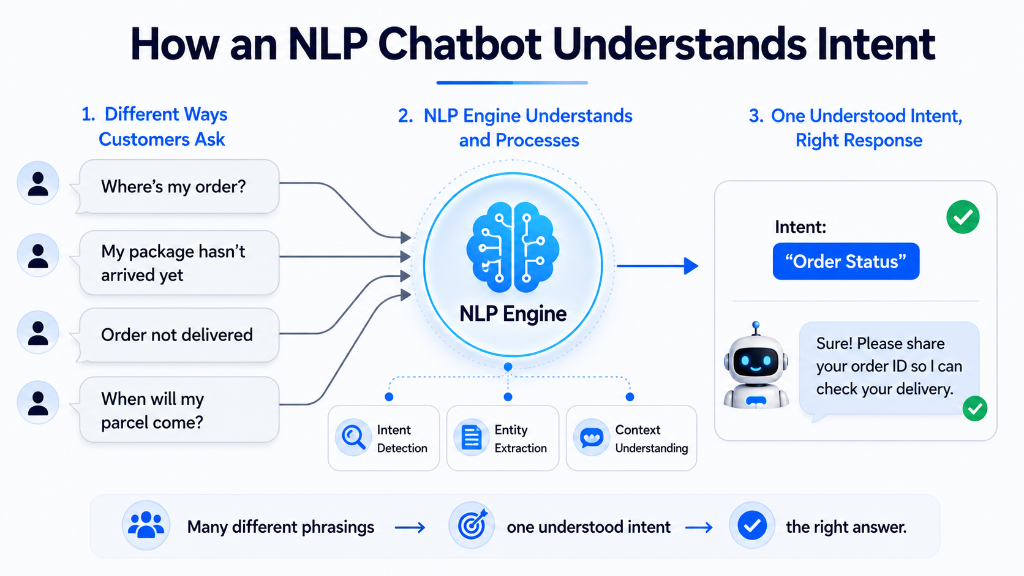
Three layers are responsible:
Once the intent and the entities are identified, the bot can respond directly, fetch some data from your systems, or hand off the conversation to a human agent. Contemporary NLP chatbots also include conversation context retention, allowing for more fluid chats.
Current benchmarks estimate accuracy of intent prediction in generative AI agents at 92% compared to 65–70% in keyword-based rule bots — the direct consequence of which is visible in the overall user experience.
Here is a realistic comparison of rule-based and NLP bots based on the current benchmarks and pricing data — not the sales deck numbers.
| Metric | Rule-Based Chatbot | NLP Chatbot |
|---|---|---|
| Setup Time | Hours to Days | Minutes (depends on the platform) |
| Custom development Cost | ~$5K–$30K | ~$75K–$150K for custom NLP; SaaS starts from free to $199/mo |
| Ongoing Maintenance | High — each new question requires new code | Low — the model scales over phrasings |
| Accuracy on unseen phrases | 65–70% (keyword-based) | ~92% (modern generative AI) |
| Containment rate | Below 35% | 40–55% average; 70–90% best-in-class |
| Cost per interaction | ~$0.50–$0.70 (vs $6–$15 for a human agent) | The same range |
| Scales with number of tickets? | No — maintenance cost increases | Yes — the bot processes 10 or 10,000 chats equally well |
| Learns from past experiences? | No | Yes, when you review conversations and retrain |
| Multilingual support | Requires dedicated builds per language | Built-in, often out of the box |
| Human handoff quality | Low — basic "I don't understand" transfer | High — context-aware, includes complete conversation history |
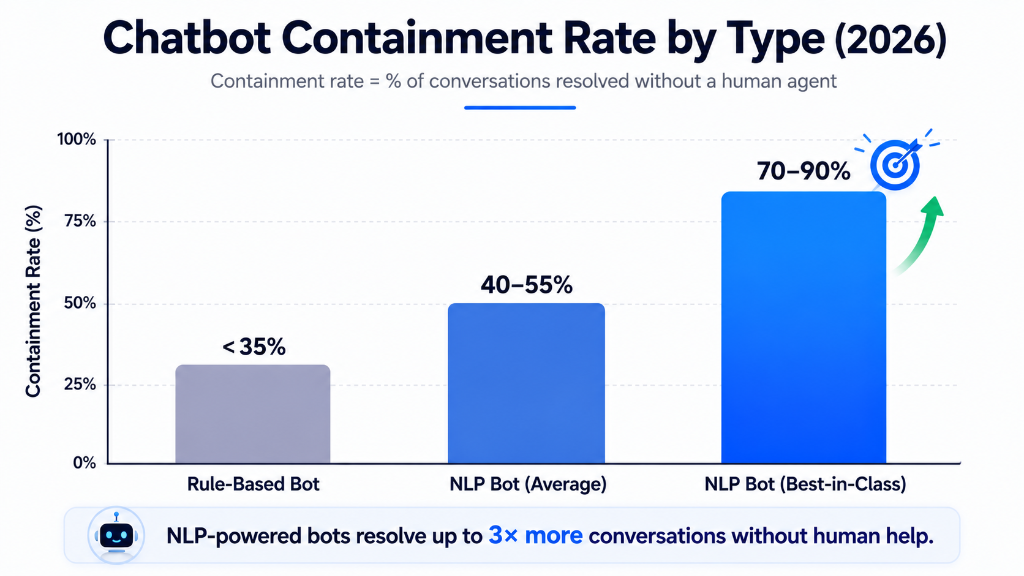
Chatbots reduce support costs by 30% claim is not the whole story here. Recent research shows that chatbots reduce support costs by 30–40% during the first year just from Tier 1 ticket deflections alone, and businesses report average ROI of 340% for the first year, or $3.50 for each dollar invested — but only when the bot is deployed correctly.
And the difference between NLP and rule-based chatbots is clearly visible in the containment rate. Consider a team handling 10,000 chats per month at $6 per human interaction:
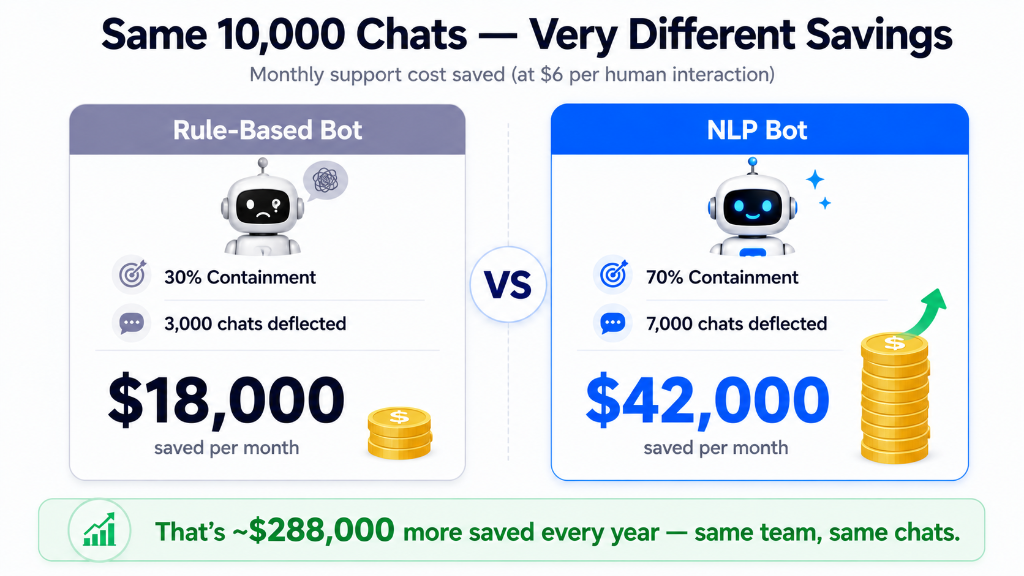
That amounts to an additional $288,000 per year in savings from the same 10,000 chats with the same team — simply because the bot understands what customers actually say.
Gartner forecasts the reduction of contact center labor cost at $80 billion by the end of 2026, and it will happen mostly due to the power of AI automation rather than rule-based bots.
For a more detailed breakdown with actual customer examples, see our blog post on how AI chatbots cut support costs by 40%.
Consider the following points to help make the decision.
Best implementations use both approaches together. NLP for intent detection and rule-based flows for the moments when the script is needed — order tracking, refunds, KYC, appointment bookings. A good platform allows combining the two without any engineering work.
If you don't feel like going through the setup process, you can use pre-trained NLP support chatbots available in most major platforms, like Botvee — they launch across web, WhatsApp, Telegram, and email in under 5 minutes, and have a free tier for up to 100 conversations per month.
Rule-based chatbot wins in month one. NLP chatbot wins every month after that because it scales with your business and does not fight it.
If your goal is to really cut support costs (rather than just installing the chatbot and praying it will), go with NLP chatbot, use rule-based flows only where you absolutely need it, and focus on measuring containment rate as your main success criterion.
The technology is finally ready for that kind of decision — the only question left is whether you want to pay for every new question, or pay once and let the bot generalize.
Rarely. The rule-based bot is cheaper only when the total question set is small and stable. Once you introduce products, languages, or promotions, the maintenance cost goes up, while NLP bots scale automatically. Most SaaS NLP tools have started charging at the same price point as the rule-based bot development.
Industry benchmarks place the average NLP chatbots at 40–55% containment and best-in-class deployments at 70–90%. Rule-based bots usually do not exceed 35%. Variability depends on the quality of knowledge base and how well the bot is integrated with your ticketing, ordering, and ID systems.
Current benchmarks put the intent-understanding accuracy of modern generative AI chatbots at 92%, compared to 65–70% in keyword-based bots. Also, advanced chatbots solve about 41% more issues than rule-based ones.
Most companies start experiencing cost reduction in 3–6 months. Deflection rate usually grows fastest in the first 90 days and plateaus until the next round of training. Average first-year ROI stands at 340%, or $3.50 for each dollar spent.
An insider’s overview of AI-powered customer support in 2026, with real figures, Pakistan-specific insights, cost reality checks, and practical takeaways.

The Botvee Team writes about AI automation, customer support trends, and practical strategies for businesses.
Get the latest AI support insights, strategies, and product updates delivered to your inbox weekly.
No spam. Unsubscribe anytime.